

Russia and EU Sanctions Brief
What is the relationship between the fur industries in the EU and Russia?
Despite EU sanctions banning the export of luxury fur products to Russia, some European countries continue to trade in different types of furskins. Loopholes in the restrictions allow raw, tanned, and dressed furskins to be exported, with Finland, Lithuania, and Greece among the key suppliers. More recently, a policy reversal has allowed an exemption for EU Member States to import sable fur from Russia following intense lobbying by the fur industry.
EU sanctions and ban on luxury fur products
The EU has imposed a number of sanctions against Russia in response to its military aggression against Ukraine. In March 2022, in its fourth package of sanctions against Russia, the EU banned the export of luxury articles of apparel, clothing accessories and other articles of furskins with a value over EUR 300.
Export of fur products has decreased significantly following the adoption of this trade restriction. The European Commission claims that between March 2022 and the end of December 2022, exports of fur products to Russia have decreased in value by 97% compared to the same period in 2021.
Area chart shows decline in EU exports of fur products to Russia, 2019-2025.
EU countries still exporting fur to Russia
Despite this decrease, trade data reveals that a number of EU countries continued to export significant amounts of furskin products to Russia. Notably, in 2023, Italy exported furskin products to Russia with a value of USD 941,000. In total, furskin products to the value of USD 2,148,000 were exported from EU countries to Russia in 2023.
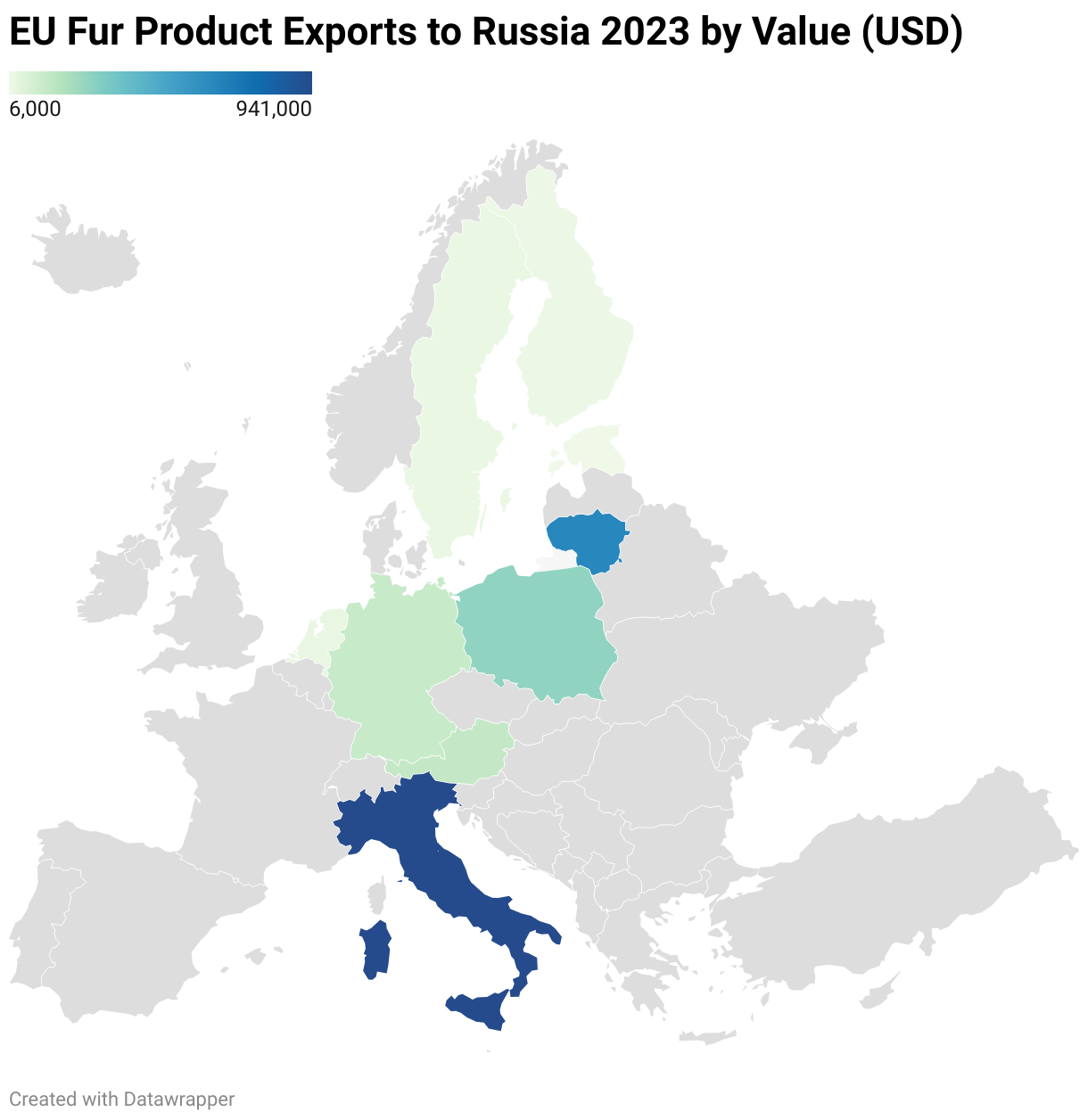
While lower, exports in 2024 were USD 1,382,000 with Lithuania exporting USD 574,000 of furskin products to Russia. In 2025, exports were USD 1,454,000 with Poland exporting USD 888,000 of furskin products to Russia.
Loopholes: raw and tanned furskins
While the fourth package of EU sanctions apply only to fur products, the export of raw furskins as well as tanned and dressed furskins to Russia is still permitted. Significant quantities of raw, tanned, and dressed furskins have been exported to Russia from Member States including Finland, Lithuania, and Greece.
For example, despite a decreasing trend in exports since 2021, Finland exported USD 2,488,000 worth of raw furskins to Russia in 2023. This reduced to USD 2,045,000 in 2024 and USD 86,000 in 2025.
In 2023, Lithuania exported USD 1,906,000 worth of tanned or dressed furskins, while Greece exported approximately USD 1 million worth. Lithuania exported USD 1,787,000 in 2024 and USD 2,032,000 in 2025.
Bar chart showing Lithuania’s exports of tanned furskins to Russia
Sable Fur Exemption
In addition to export restrictions, the EU has also adopted restrictions on goods that EU Member States can import from Russia. In April 2026, the EU adopted its 20th package of sanctions against Russia. These measures included restrictions on the import of goods which generate significant revenues for Russia, including, among other things, tanned furskins.
However, the EU’s 21st package of sanctions adopted in July 2026 removed Russian sable fur pelts from this restriction following intense lobbying by the Italian and Greek fur industries. This exemption risks undermining the principles of the sanctions by allowing Russian companies to profit from this non-essential material.
Timeline showing EU’s sanctions against Russia pertaining to fur